Have you ever stopped while writing an email because you were unsure whether to use stationary or stationery? You are not alone. These two words sound almost the same, but they have very different meanings. Choosing the wrong one can change the meaning of your sentence and make your writing look less professional.
The confusion between stationary or stationery is common among students, teachers, office workers, and people learning English. Both words are spelled correctly, but they are not interchangeable. One describes something that does not move, while the other refers to paper, pens, envelopes, and other writing supplies.
For example, a car that does not move is stationary. A notebook you use to write notes is stationery. The difference seems small, but knowing which word to use can help you avoid spelling mistakes in schoolwork, business emails, reports, and everyday messages.
In this guide, you will learn the meanings, origins, and correct uses of both words. You will also find simple examples, a comparison table, common mistakes, and answers to frequently asked questions. By the end, you will know how to choose the right word with confidence.
Stationary or Stationery – Quick Answer
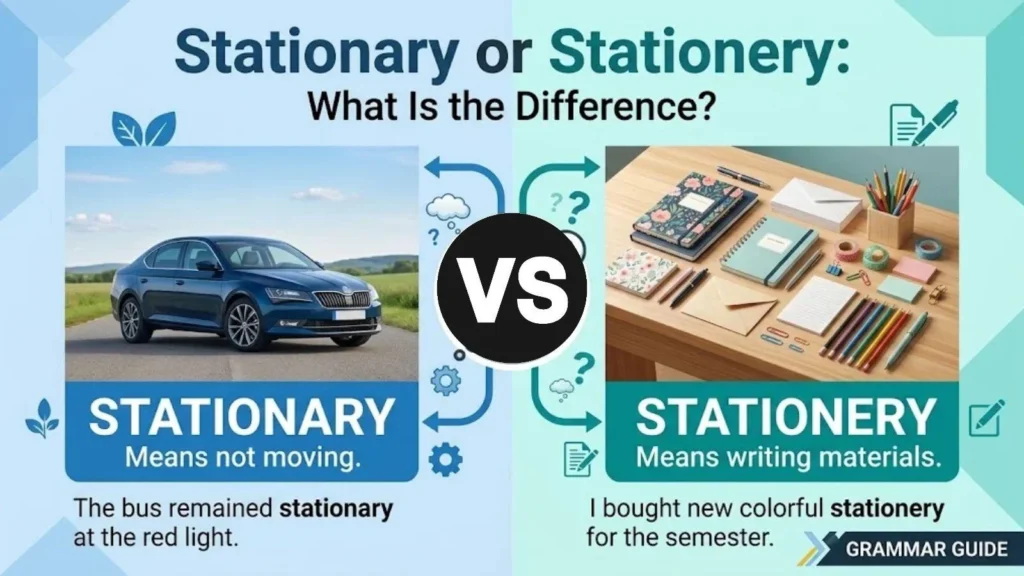
Stationary means staying still or not moving. Stationery means writing materials, such as paper, pens, envelopes, and notebooks.
Here is a simple way to remember the difference:
- Stationary = still. The bicycle remained stationary near the gate.
- Stationery = supplies. I bought new stationery for school.
Both words are correct, but they have different uses.
Quick Examples
Stationary:
- The bus remained stationary at the stop.
- Please keep the camera stationary.
- The machine must stay stationary during the test.
Stationery:
- I need new stationery for my office.
- She bought colorful stationery for school.
- The company ordered printed stationery for its letters.
Memory trick: Stationary has an a, like at rest. Stationery has an e, like envelope.
The Origin of Stationary or Stationery
The words stationary and stationery share a historical connection with the word station. However, their meanings developed in different directions.
The Origin of Stationary
The word stationary comes from Latin stationarius, which relates to standing or being in a fixed position. It entered English through French and Latin influences.
Over time, stationary came to describe people or things that remain in one place rather than moving.
Examples include:
- A stationary bike that stays in one place.
- A stationary object that does not move.
- A stationary guard who remains at a fixed post.
Today, the word is common in science, transport, education, and everyday conversation.
The Origin of Stationery
The word stationery also comes from the history of stations and fixed places. In medieval England, a stationer was a person who sold books, paper, and writing materials from a fixed shop or stall.
The word eventually became associated with the products sold by these merchants. Today, stationery includes items such as paper, notebooks, envelopes, greeting cards, and pens.
Examples include:
- Wedding stationery, such as invitations and response cards.
- Office stationery, such as letterheads and envelopes.
- School stationery, such as pencils, notebooks, and rulers.
Why Are the Words So Similar?
Both words share a common historical root and have similar pronunciations. Their endings, however, reflect different meanings and word histories.
Because the final sounds are often identical in English, people may confuse the spellings when writing quickly.
The key is to remember that stationary describes a state of stillness, while stationery names a group of writing products.
British English vs American English Spelling
Unlike words such as colour and color, stationary and stationery do not have different British and American spellings.
Both forms are spelled the same way in British English, American English, Canadian English, and Australian English. The difference is based on meaning, not geography.
Spelling Comparison Table
| Word | British English | American English | Meaning |
|---|---|---|---|
| Stationary | Stationary | Stationary | Not moving |
| Stationery | Stationery | Stationery | Writing materials |
| Stationary vehicle | Stationary vehicle | Stationary vehicle | A vehicle that is not moving |
| Office stationery | Office stationery | Office stationery | Office writing supplies |
| Stationary bicycle | Stationary bicycle | Stationary bicycle | A bicycle fixed in place |
Examples in British English
- The car remained stationary outside the shop.
- I bought some stationery for my classroom.
- Please order more office stationery.
Examples in American English
- The truck stayed stationary near the entrance.
- I need stationery for my new office.
- She bought stationery for writing letters.
The spellings remain unchanged in both varieties of English. Writers should focus on the meaning of each word rather than trying to choose a regional spelling.
Which Spelling Should You Use?
The correct choice depends on what you want to say, not where your readers live.
For American Readers
Use stationary when describing something that does not move. Use stationery when referring to writing supplies.
Examples:
- The vehicle remained stationary.
- We ordered new stationery for the office.
For British and Commonwealth Readers
The same rule applies in the United Kingdom, Pakistan, Australia, Canada, and other English-speaking settings.
Examples:
- The train was stationary for several minutes.
- The school purchased stationery for its students.
For a Global Audience
If you write for an international audience, use the standard spellings and make the meaning clear through context.
For business writing, check your sentence before sending it. A sentence such as “We need more stationary” is incorrect if you mean paper and pens. The correct sentence is “We need more stationery.”
For professional communication, remember these guidelines:
- Use stationary for something that remains still.
- Use stationery for writing supplies.
- Proofread emails, reports, and documents.
- Use examples or extra details if the meaning might be unclear.
There is no need to change either spelling for a US, UK, or global audience.
Common Mistakes with Stationary or Stationery
Many spelling mistakes happen because the words sound alike. Here are common errors and how to correct them.
Mistake 1: Using Stationary for Writing Supplies
Incorrect: I bought new stationary for school.
Correct: I bought new stationery for school.
Use stationery when talking about notebooks, pens, paper, and similar products.
Mistake 2: Using Stationery to Describe Something Still
Incorrect: The car remained stationery at the crossing.
Correct: The car remained stationary at the crossing.
Use stationary when something does not move.
Mistake 3: Confusing Stationery with Stationary Equipment
Incorrect: The laboratory needs stationery equipment that does not move.
Correct: The laboratory needs stationary equipment that does not move.
In this example, the writer is describing equipment that stays in one place.
Mistake 4: Assuming One Spelling Is British and the Other Is American
Incorrect: Stationary is British, while stationery is American.
Correct: Both spellings are used in British and American English, but their meanings differ.
Mistake 5: Relying Only on Pronunciation
Because both words often sound alike, listening alone may not help you choose the correct spelling.
Tip: Think about the meaning before writing. Is the subject staying still, or are you talking about paper and pens?
Easy Ways to Remember the Difference
- Stationary: think of something at rest.
- Stationery: think of an envelope.
- If you can buy it in a shop that sells paper and pens, it is probably stationery.
- If it describes something that is not moving, it is stationary.
Stationary or Stationery in Everyday Examples
Both words appear in everyday writing, but they are used in different situations.
1. In Emails
Stationary:
“Please keep the camera stationary while recording the presentation.”
Stationery:
“Could you please order more stationery for the office?”
The first sentence describes an object that should not move. The second asks for writing supplies.
2. In News Reports
Stationary:
“The vehicle remained stationary on the road while emergency workers assisted the driver.”
Stationery:
“The company announced a new range of eco-friendly stationery products.”
News reports use stationary to describe movement and stationery when discussing writing products.
3. On Social Media
Stationary:
“My bike stayed stationary while I adjusted the seat.”
Stationery:
“Look at this beautiful stationery set I bought today!”
Social media posts often use both words when discussing daily activities, hobbies, school, or work.
4. In Schoolwork
Stationary:
“The diagram shows a stationary object.”
Stationery:
“Students should bring their stationery to class.”
Students can avoid errors by remembering the difference between an object’s movement and writing supplies.
5. In Business Writing
Stationary:
“The machine must remain stationary during the inspection.”
Stationery:
“Please use the company stationery for official letters.”
These examples show why the distinction matters in professional settings. The wrong spelling can make a message confusing or less polished.
6. In Formal Reports
Stationary:
“The sensor recorded the position of a stationary object.”
Stationery:
“The department’s stationery budget increased this year.”
Always check the meaning before choosing the spelling in formal documents.
Stationary or Stationery – Google Trends & Usage Data
People often search for “stationary or stationery” because the words sound alike and are easy to confuse. The search phrase reflects a common spelling question rather than a difference between British and American English.
However, exact Google Trends popularity can change by country, date range, and search category. Without a current Trends comparison, it would be misleading to claim precise search volumes or rank one country as the most interested.
Usage by Country
| Country or Region | Common Contexts | Spelling Rule |
|---|---|---|
| United States | Office supplies, transport, schoolwork | Both spellings are standard |
| United Kingdom | Business letters, education, shopping | Both spellings are standard |
| Pakistan | School supplies, office writing, English learning | Both spellings are standard |
| Australia | Education, business, everyday writing | Both spellings are standard |
| Canada | Office supplies, transport, education | Both spellings are standard |
Why Do People Search for These Words?
Common reasons include:
- Checking which spelling is correct.
- Learning English vocabulary.
- Preparing school assignments or exams.
- Writing professional emails and reports.
- Shopping for stationery products.
- Improving spelling and grammar.
How to Explore Google Trends
You can compare interest in the two words using Google Trends.
For a useful comparison:
- Enter “stationary” and “stationery” as separate search terms.
- Select the countries you want to compare.
- Choose a time range, such as the past 12 months.
- Compare search interest and related queries.
- Remember that Trends uses relative interest scores, not exact search counts.
The main lesson remains the same in every country: stationary describes stillness, while stationery means writing supplies.
Stationary vs Stationery: Comparison Table
Use this table for a quick review of the differences.
| Feature | Stationary | Stationery |
|---|---|---|
| Part of speech | Adjective | Noun |
| Main meaning | Not moving | Writing materials |
| Common examples | Stationary car, stationary object | Paper, pens, envelopes |
| Used in transport | Yes | No, unless referring to supplies |
| Used in offices | Describes fixed equipment | Names office supplies |
| British spelling | Stationary | Stationery |
| American spelling | Stationary | Stationery |
| Memory clue | A = at rest | E = envelope |
Compare These Sentences
| Sentence | Correct Word | Why? |
|---|---|---|
| The bus remained ___ at the stop. | Stationary | The bus was not moving. |
| I need to buy more ___. | Stationery | The speaker needs writing supplies. |
| The camera must remain ___. | Stationary | The camera must stay still. |
| She ordered personalized wedding ___. | Stationery | The items include invitations and cards. |
| The machine stayed ___ during the test. | Stationary | The machine did not move. |
These examples show that the correct choice depends on what the sentence means.
Frequently Asked Questions (FAQs)
1. Is it stationary or stationery?
Both words are correct, but they have different meanings. Stationary means not moving, while stationery means writing materials such as paper, pens, and envelopes.
2. How can I remember stationary vs stationery?
Remember that stationary has an a, like “at rest.” Stationery has an e, like “envelope.” This simple trick can help you choose the correct spelling.
3. Is stationery a British or American word?
Stationery is used in both British and American English. Its spelling does not change between these varieties.
4. Can stationary be used as a noun?
Stationary is most commonly used as an adjective, as in “a stationary car.” It can also appear in specialized technical or scientific contexts, but everyday writing usually uses it to describe something that does not move.
5. What is an example of stationery?
Examples of stationery include notebooks, writing paper, envelopes, letterheads, greeting cards, and other writing materials.
6. Is a stationary bike or stationery bike correct?
Stationary bike is correct. It refers to an exercise bike that stays in one place while you pedal.
7. Why do stationary and stationery sound the same?
Their pronunciation is often identical because English spelling does not always match pronunciation. Their shared historical roots also help explain their similarity.
8. Which word should I use in a business email?
Use stationary when describing something that stays still, such as a camera or machine. Use stationery when referring to office supplies or printed business materials.
Conclusion
The difference between stationary and stationery is simple once you connect each word with its meaning. Stationary describes something that stays still or does not move. Stationery refers to writing supplies, including paper, pens, envelopes, notebooks, and letterheads.
Although these words sound alike, they are not interchangeable. Writing “the car remained stationery” is incorrect when you mean that the car did not move. Likewise, writing “I bought new stationary” is incorrect when you mean that you purchased paper and pens.
The good news is that the spelling rule is the same in British English, American English, and other major varieties of English. You do not need to memorize separate regional versions. Instead, focus on the meaning of your sentence.
For an easy memory trick, think of A for at rest in stationary and E for envelope in stationery. This small reminder can help you avoid mistakes in school assignments, office emails, business reports, and everyday messages.
When in doubt, pause and ask yourself one question: Am I describing something still, or am I talking about writing supplies? Your answer will help you choose the right word every time.