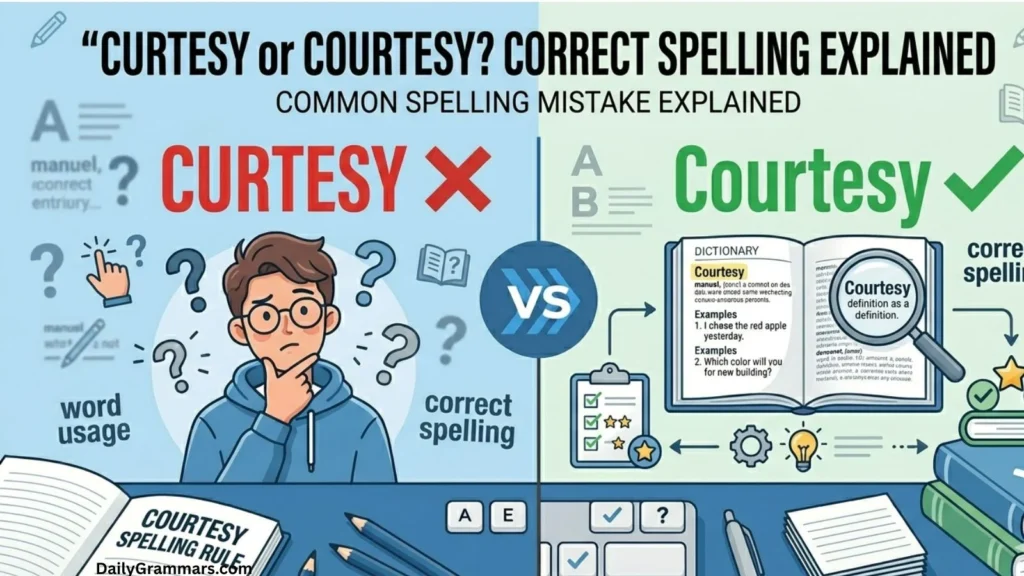
Have you ever typed “curtesy” and wondered if it was correct? Many people search for “curtesy or courtesy” because the two words look and sound similar.
Spell-check tools may even confuse users when typing fast. This spelling mix-up is common in emails, school work, social media posts, and professional writing.
|See also Leach or Leech
The good news is simple: only one spelling is correct in most situations. The word “courtesy” means polite behavior, respect, or a kind action. “Curtesy” is an old legal term that most people never use today. Because both words exist in English, many writers are unsure which one belongs in daily writing.
This guide explains the difference between “curtesy” and “courtesy” in clear and simple language. You will learn the correct spelling, the history of both words, British and American English usage, common mistakes, and real-life examples. By the end, you will know exactly which spelling to use in every situation.
Curtesy or Courtesy – Quick Answer
The correct spelling for polite behavior is courtesy.
Correct Example
- Thank you for your courtesy and support.
Incorrect Example
- Thank you for your curtesy and support.
The word courtesy means kindness, respect, or good manners.
The word curtesy is a rare legal term from old English law. Most people never need to use it.
Quick Comparison Table
| Word | Meaning | Common Today? |
|---|---|---|
| Courtesy | Politeness, respect, kindness | Yes |
| Curtesy | Old legal term | No |
The Origin of Curtesy or Courtesy
The word courtesy comes from the Old French word courtoisie. It later entered Middle English. The word was linked to polite behavior shown in royal courts. Over time, it became the modern English word for kindness and respect.
The word curtesy has a very different history. It came from old legal language in England. It referred to a husband’s legal rights over his wife’s property after her death. Today, this meaning is outdated and rarely used.
Because the two words sound alike, many people accidentally spell “courtesy” as “curtesy.” Modern English keeps “courtesy” as the standard spelling for normal communication.
British English vs American English Spelling
There is no major spelling difference between British English and American English for this word.
Both countries use courtesy as the correct modern spelling.
Examples
| Region | Correct Spelling | Example |
|---|---|---|
| American English | Courtesy | Please accept this courtesy gift. |
| British English | Courtesy | He thanked her for her courtesy. |
| Canadian English | Courtesy | Courtesy matters in business. |
| Australian English | Courtesy | Basic courtesy is important. |
Important Note
“Curtesy” is not a British spelling of “courtesy.” It is a separate old legal word.
Which Spelling Should You Use?
You should use courtesy in almost every situation.
Use “Courtesy” If You Write For:
- American audiences
- British audiences
- Canadian audiences
- Australian audiences
- Global readers
- Schools and universities
- Business communication
- Social media and blogs
Use “Curtesy” Only If:
- You are discussing old legal history
- You are writing about historical English law
For modern writing, “courtesy” is always the safe and professional choice.
Common Mistakes with Curtesy or Courtesy
Many writers make simple spelling mistakes with this keyword.
Common Errors and Corrections
| Incorrect | Correct |
|---|---|
| Curtesy call | Courtesy call |
| Curtesy email | Courtesy email |
| Thank you for your curtesy | Thank you for your courtesy |
| Common curtesy | Common courtesy |
Why the Mistake Happens
- Both words sound similar
- Fast typing causes spelling errors
- Autocorrect may not catch it
- “Curtesy” is still a real word in dictionaries
Easy Memory Trick
Think of the word court inside courtesy. Good manners often come from polite social behavior.
Curtesy or Courtesy in Everyday Examples
Here are simple examples of the correct usage.
In Emails
- Thank you for your courtesy during our meeting.
- We appreciate your courtesy and patience.
In News Writing
- The company offered courtesy transportation to customers.
- The mayor thanked the staff for their courtesy.
On Social Media
- A little courtesy goes a long way.
- Please show courtesy in the comments section.
In Formal Writing
- Professional courtesy is important in business.
- Courtesy and respect improve workplace culture.
Incorrect Everyday Usage
- Thank you for your curtesy. ❌
Curtesy or Courtesy – Google Trends & Usage Data
Search data shows that “courtesy” is far more popular worldwide.
Usage by Country
| Country | Popular Spelling |
|---|---|
| United States | Courtesy |
| United Kingdom | Courtesy |
| Canada | Courtesy |
| Australia | Courtesy |
| India | Courtesy |
Why People Search “Curtesy or Courtesy”
People usually search this keyword because:
- They want the correct spelling
- They saw both words online
- Spell-check created confusion
- They need professional writing help
Online Usage Trends
- “Courtesy” appears in books, websites, and business writing every day.
- “Curtesy” mostly appears in legal history documents.
Comparison Table: Curtesy vs Courtesy
| Feature | Courtesy | Curtesy |
|---|---|---|
| Correct for politeness | Yes | No |
| Modern English use | Very common | Very rare |
| Used in business writing | Yes | No |
| Used in legal history | No | Yes |
| Accepted worldwide | Yes | No |
| Common search confusion | Yes | Yes |
FAQs:
- What is the difference between courtesy and curtesy?
Courtesy means politeness or respect, while curtesy is an old legal term rarely used today. - Which is a courtesy?
Courtesy is the correct modern word for kindness, polite behavior, or respectful actions. - Is curtesy an outdated term?
Yes, curtesy is an outdated legal word and is almost never used in everyday English. - Is it courtesy or curtesy of someone?
The correct phrase is “courtesy of someone,” which means provided or given by someone. - What does curtesy mean?
Curtesy was an old English legal term related to a husband’s rights to his wife’s property after her death. - When should you curtsy or curtsey?
You curtsy or curtsey as a polite bow mainly in formal traditions, royal events, or dance performances.
Conclusion
The difference between “curtesy” and “courtesy” is simple once you understand the meaning of each word. In modern English, courtesy is the correct spelling for kindness, respect, and polite behavior.
It is the word used in schools, businesses, news articles, emails, and daily conversations across the world.
The word curtesy is a rare legal term from old English law. Most people will never need to use it. That is why using “curtesy” in normal writing often looks like a spelling mistake.
If you want safe, professional, and clear communication, always choose courtesy. This spelling works in both British and American English and is accepted globally. A simple way to remember it is to connect “courtesy” with polite social behavior and respect.
When in doubt, use “courtesy.” It is the correct modern spelling for almost every situation.