Many people search for “chose or choose” because the two words look almost the same. They also sound similar when spoken fast. This often causes spelling mistakes in emails, school work, social media posts, and even business writing.
|See also Leach or Leech
The confusion usually happens because both words come from the same verb. One talks about the present or future, while the other talks about the past. If you use the wrong one, your sentence may sound strange or grammatically incorrect.
For example:
- “I choose pizza every Friday.” ✅
- “Yesterday, I chose pizza.” ✅
- “Yesterday, I choose pizza.” ❌
This guide explains the difference between chose and choose in simple English. You will learn the meaning, spelling rules, common mistakes, real-life examples, and which form to use in American and British English. By the end, you will know exactly when to use each word with confidence.
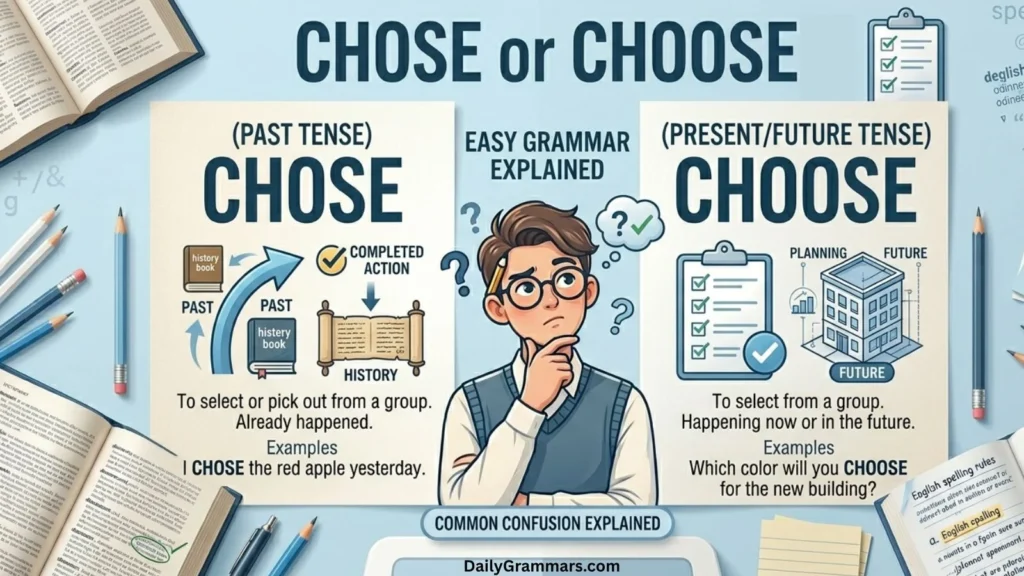
Chose or Choose – Quick Answer
The difference is simple:
| Word | Meaning | Tense | Example |
|---|---|---|---|
| Choose | To pick something | Present/Future tense | “I choose coffee.” |
| Chose | Picked something already | Past tense | “I chose coffee yesterday.” |
Easy Rule
- Use choose for actions happening now or later.
- Use chose for actions that already happened.
Examples:
- “Please choose a color.”
- “She chose the blue dress.”
- “We will choose a winner tomorrow.”
- “They chose a new manager last week.”
The Origin of Chose or Choose
The words choose and chose come from Old English. The original word was similar to “ceosan,” which meant “to select” or “to decide.”
Over time, English grammar changed. Different verb forms developed for present and past actions.
Why the Spelling Changes
English has many irregular verbs. Instead of adding “-ed” for the past tense, the vowel inside the word changes.
Examples:
| Present | Past |
|---|---|
| Choose | Chose |
| Speak | Spoke |
| Break | Broke |
| Drive | Drove |
That is why choose becomes chose instead of “choosed.”
British English vs American English Spelling
Good news: there is no spelling difference between British English and American English for these words.
Both countries use:
- Choose = present tense
- Chose = past tense
Comparison Table
| English Type | Present Tense | Past Tense | Example |
|---|---|---|---|
| American English | Choose | Chose | “I chose a movie.” |
| British English | Choose | Chose | “She chose tea.” |
| Australian English | Choose | Chose | “They choose wisely.” |
| Canadian English | Choose | Chose | “He chose the red car.” |
Important Note
The spelling stays the same worldwide. Only pronunciation accents may sound slightly different.
Which Spelling Should You Use?
The correct word depends on the time of the action.
Use “Choose” When:
- The action is happening now
- The action will happen later
- Giving instructions or advice
Examples:
- “Choose your favorite song.”
- “I always choose healthy food.”
- “You can choose tomorrow.”
Use “Chose” When:
- The action already happened
- Talking about past decisions
Examples:
- “I chose the cheaper option.”
- “She chose science in college.”
- “They chose a new office last year.”
Audience-Based Advice
| Audience | Best Choice |
|---|---|
| US readers | Use standard grammar rules |
| UK readers | Use standard grammar rules |
| Commonwealth countries | Same spelling rules |
| Global audience | Keep sentences simple and clear |
The rule never changes:
Choose = present
Chose = past
Common Mistakes with Chose or Choose
People often mix these words because they type quickly or forget the tense.
Common Errors
| Incorrect | Correct |
|---|---|
| “Yesterday I choose a car.” | “Yesterday I chose a car.” |
| “Please chose one.” | “Please choose one.” |
| “She choose the winner.” | “She chose the winner.” |
| “I have chose this option.” | “I have chosen this option.” |
Important Grammar Tip
After “have,” “has,” or “had,” use chosen, not chose.
Correct examples:
- “I have chosen a name.”
- “She has chosen a dress.”
Incorrect:
- “I have chose a name.” ❌
Chose or Choose in Everyday Examples
Emails
- “Please choose a meeting time.”
- “We chose Monday for the event.”
News Writing
- “Voters chose a new leader.”
- “Customers choose online shopping more often.”
Social Media
- “Choose happiness today!”
- “I chose peace over drama.”
Formal Writing
- “The company chose a new strategy.”
- “Students may choose two subjects.”
Chose or Choose – Google Trends & Usage Data
Search data shows that many people look for “chose or choose” because English learners and native speakers both confuse the words.
Countries With High Search Interest
- Pakistan
- India
- United States
- United Kingdom
- Philippines
Why People Search This Keyword
Users usually want to know:
- Which spelling is correct
- Present vs past tense
- Grammar help for writing
- Correct use in sentences
Usage Context
| Context | Common Word |
|---|---|
| Instructions | Choose |
| Past stories | Chose |
| Business writing | Both |
| Academic writing | Both |
| Social media captions | Both |
Comparison Table: Chose vs Choose
| Feature | Choose | Chose |
|---|---|---|
| Part of Speech | Verb | Verb |
| Tense | Present/Future | Past |
| Meaning | Select something | Selected something |
| Time | Now or later | Already happened |
| Example | “Choose wisely.” | “She chose wisely.” |
FAQs:
Should I use chose or choose?
Use choose for present/future actions and chose for past actions.
Why does “choose” mean?
“Choose” means to pick or select something from options.
How do you use choose in a sentence?
“I choose tea every morning.” / “Please choose your answer.”
Is it today I chose or today I choose?
Use “today I choose” (present action happening today).
Is it choosing or chosing?
Correct spelling is “choosing”. “Chosing” is wrong.
What is the meaning of “chose”?
“Chose” means the past form of choose — already selected something.
Is “chose” a commonly misused word?
Yes, many learners confuse it with “choose” because of tense changes.
Conclusion
Understanding the difference between chose and choose is easier than many people think. The key is remembering the time of the action. Use choose when talking about the present or future. Use chose when talking about something that already happened.
This small grammar rule can make your writing clearer and more professional. Whether you are writing emails, social media posts, business reports, or school assignments, using the correct word helps readers understand you better.
There is also no difference between British English and American English for these spellings. The grammar rule stays the same everywhere. That makes learning the correct usage much simpler.
A quick way to remember the rule is this:
- Choose = now or later
- Chose = already happened
If you still feel unsure, read your sentence and ask yourself: “Did this action happen in the past?” If yes, use chose. If not, use choose. With practice, the difference will soon feel natural.